Logo vs Brand Identity: What Are You Actually Paying For?
Logo vs Brand Identity: What Are You Actually Paying For?
“We just need a logo.” Fair enough and sometimes that’s true.
But majority of the time those businesses are inviting in issues that come with "Just a logo".
Your business looks inconsistent or your website doesn’t feel as strong as your work. Your proposals looks different from the social posts and your team has to keep making things from scratch.
The brand feels a bit cheap, a bit dated, or a bit unclear, but the logo is the easiest thing to point at. So naturally the conversation becomes about the logo.
But the logo might only be one part of the problem.
Where we see a lot of businesses get confused by branding quotes. You'll have one designer who charges a few hundred dollars for a logo but then another will charge thousands for brand identity work. Both seem like what you're after but at face value, that feels ridiculous. Surely they’re both just designing a logo mark?
Not really.
A logo gives your business a recognisable symbol. But brand identity gives your business a way to be consistent across your market and customer touch points: your website, proposals, sales material, social posts, ads, documents, signage, email signatures and every other place customers meet you.
That’s a much bigger job. And if your actual problem is consistency, trust, positioning or how your business is being perceived, a logo on its own won’t carry the weight.
Want to find out what makes a strong brand overall? Check out our article on strong brands.
Logos identify your business
Logo's are 100% necessary for any business and it's important to take them seriously.
It gives your business a visual anchor. It helps people recognise you. It gives your name a mark, symbol or lockup that can be used across your website, signage, documents and marketing.
Your logo should feel appropriate for the business. It should be clear, usable, scalable and recognisable. It shouldn’t fall apart when it’s used small, reversed out, printed, placed on a social profile, or dropped into a proposal.
That’s the practical side people often forget.
For example, we've worked with a couple businesses who used branding colours as their font colour. Looked good on the website or on white space. But if you added any slightly darker colour behind it - good luck reading it.
Your logo isn’t just something that looks nice on a white background. It has to survive real use. And even a great logo has limits.
It won’t tell your team how to design a proposal. It won’t decide your colours, fonts, imagery, tone, templates or messaging. It won’t make your website feel consistent with your sales deck. It won’t stop a contractor from using the wrong version or stretching it into some horrid shape in Canva.
That’s why a logo is important, but it isn’t the whole brand. It identifies the business, but it doesn’t give the business a full system for showing up.
Brand identity gives your business a system
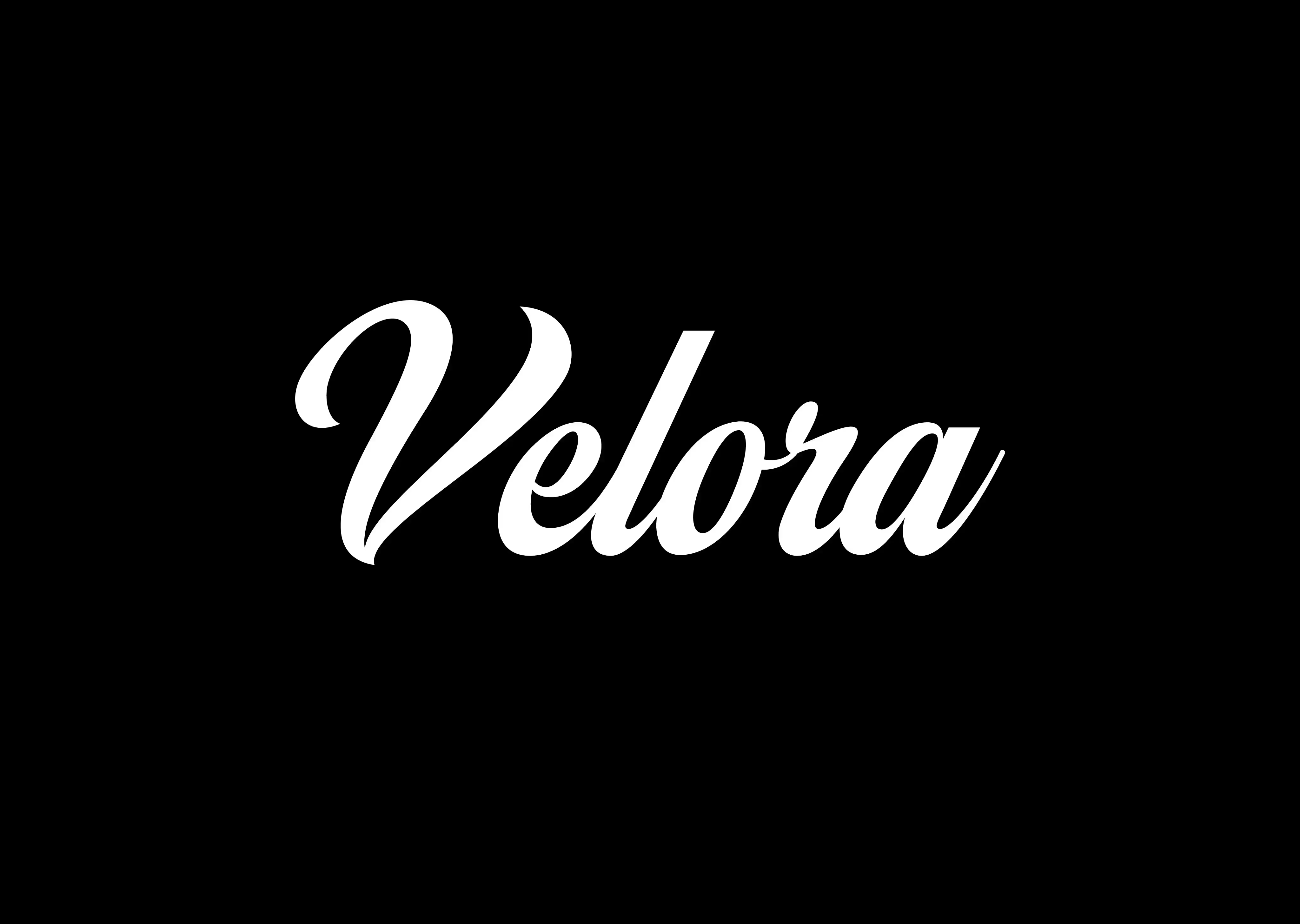
Your brand identity is the system around the logo. what It gives your business a consistent way to look, sound and feel across every place people meet it.
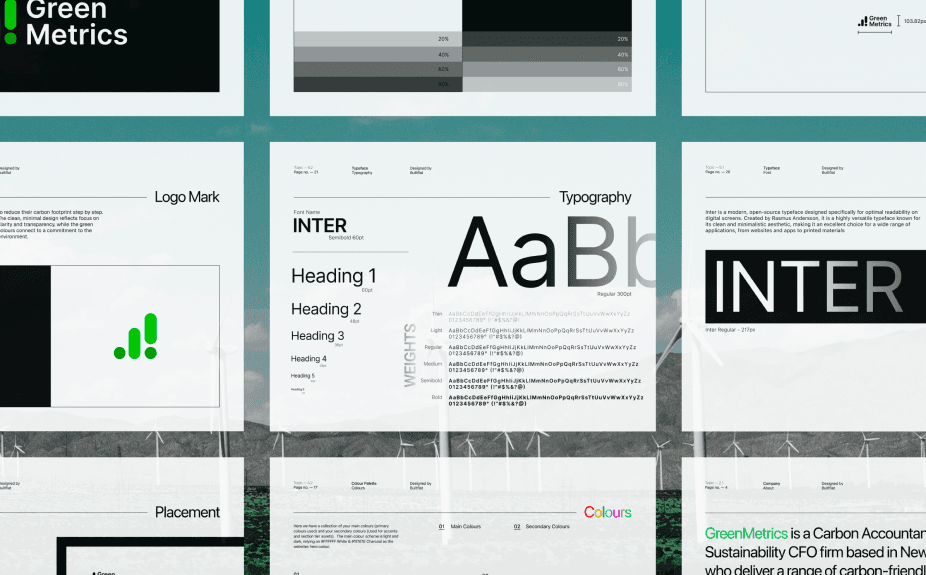
Brand identity normally includes your logo suite, colour palette, typography, imagery style, layout direction, messaging, tone of voice, templates, usage rules and brand guidelines.
The exact scope depends on your business and needs but as you can see, it's broader than "Just a logo".
If you're a small startup, you might need a lean identity system that gets them moving. Or if you're a more established service business, you might need a deeper identity that works across the website, proposals, documents, ads, signage, presentations and internal material.
The point is the same either way: Your brand identity should make decisions easier.
Instead of everyone guessing which colour to use, how a heading should look, what type of imagery feels right, or how a document should be laid out, there’s a system to work from.
That’s what you’re paying for.
Not just a prettier logo. Not just a few colours. Not just a PDF that looks nice and disappears on your internal server.
You’re paying for a clearer way for your business to show up consistently everyday.
Why a logo alone often isn’t enough
Your logo can be well designed but not solve the actual problem.
We see this happen a lot, and probably more than businesses care to admit.
Your logo looks perfectly fine - and maybe it’s even good. But everything around it is inconsistent, unclear or underdeveloped.
Your website uses one style. Your proposals use a slightly different version. Social posts are being made from scratch each time. Your sales deck feels like it belongs to an older version of the business. The email signature has a stretched logo from 2018 that no one wants to talk about.
At that point, the issue isn’t “we need a new logo.” The issue is that the business doesn’t have a clear identity system.
It's crucial because your customers don’t experience your logo in isolation. They experience the whole brand around it. And that inconsistency grows everyday when interpretation is left to your team.
Everything feels disconnected, and your business starts to feel less controlled than it probably is.
That creates doubt. And doubt doesn’t help people buy.
A logo alone can’t carry your positioning. It can’t set your tone. It can’t explain your value. It can’t make your team use the brand properly. It can’t make your website, proposal and marketing material feel like one joined-up business.
That’s why cheap logo design often feels appealing at first, then limiting later because you don't get the whole system.
What you’re actually paying for with brand identity work
As I said before, it's easy to look at a quote for a logo and brand identity and think it's absolutely ridiculous. But the difference is when you pay for brand identity work, you’re not just paying for someone to draw a logo - you’re paying for thinking.
That’s the bit people don't understand or undervalue because you can’t always see it sitting on the page. It's not tangible. It's experience, understanding, creativity, strategy and thinking combined.
Good brand identity work starts by understanding the business. Who you are. Who you’re trying to attract. What level you want to operate at. What your customers need to believe about you. What the market currently misunderstands. What you’re trying to stop signalling.
Then the design decisions have a job.
The colours aren’t just “nice colours.” The typography isn’t just someone’s favourite font. The logo isn’t just a clever mark. The layout, imagery, tone and templates all need to support the impression the business is trying to create.
That’s where the cost difference usually comes from.
Anyone can go pick out a random font that looks nice, but it takes experience to know what font engages particular audiences better, what it makes them feel, what not touse, and what fits in with the bigger picture.
Any cheap logo project will give you a usable visual mark and sometime's thats enough for some businesses.
But a proper brand identity project will give you direction, rules, assets and application. It'll help your business show up clearly across real customer touchpoints.
You’re paying for the difference between:
“Here’s your logo.”
And:
“Here’s how your business should show up.”
When a logo might be enough for your business
Don't get me wrong, sometimes a logo is actually enough.
There’s no need to pretend every business needs a full brand identity project from day one.
If you’re testing a small idea, launching a side project, creating an internal initiative, running a short-term event, or building something that doesn’t need to carry much trust yet, a simple logo can do the job.
Not every project needs strategy workshops, brand guidelines, templates and a full identity system. Sometimes you just need a mark that looks decent, works clearly, and gives the thing a name and face.
What I'm trying to communicate is the danger is expecting that logo to solve bigger business problems.
If your brand needs to support higher pricing, sales material, a website, ad campaigns, proposals, social content, staff usage and customer trust, a standalone logo will probably run out of road pretty quickly.
That’s when the cheaper option starts getting expensive. And it's not always because it might turn customers away - But it costs the opportunity of your businesses growth.
When you need a full brand identity
If your business is customer-facing, your brand isn’t just sitting on a business card. It’s showing up across your website, proposals, quotes, social content, ads, email signatures, brochures, signage, sales decks and internal documents.
That’s a lot of places for things to trail off if they're not thought out, created and controlled.
A full identity becomes more important when multiple people need to use the brand. Your staff, contractors, designers, marketers, salespeople, agencies. If everyone is making small decisions their own way, your brand can slowly lose it's shape.
You may need more than a logo if:
- your business is trying to look more established
- you want to support higher pricing
- your website and sales material feel disconnected
- your team keeps guessing how things should look
- your brand needs to work across lots of touchpoints
- you’re being compared on price too often
- you’re attracting the wrong type of enquiry
That’s when identity work starts to matter commercially. It gives the business a clearer system to work from, and it gives your customers a more consistent impression to trust.
Tossing up the idea of a full brand identity or a logo? Check out our rebrand vs refresh article here.
The "identity use" test
Before you decide if you need a logo or a full identity, ask how the brand actually needs to be used.
Start with these questions:
Where will this brand need to show up?
If it only needs to sit on one simple page or a small project, a logo might be enough.
If it needs to work across a website, proposals, social content, ads, email signatures, signage and client documents, you’re probably looking at an identity system.
Who will need to use it?
If one person controls everything, you can sometimes get away with less structure.
If staff, contractors, agencies or different departments need to use the brand, you need clearer rules. Otherwise, everyone starts interpreting it in their own way.
What keeps getting recreated from scratch?
If every new proposal, post, document or campaign starts from nothing, your brand isn’t giving the team enough direction. A good identity system will reduce that guesswork and how ever many hours it takes to recreate it.
What do customers need to feel before they enquire?
This is more necessary than people think.
Do they need to feel that you’re premium? Safe? Experienced? Local? Specialist? Reliable? Easy to work with?
Those signals won’t come from the logo alone. They come from the wider identity, message and application.
What would inconsistency cost over the next year?
A messy brand doesn’t just look annoying.
It costs time, trust and sometimes sales. People redo the same work. Materials don’t match. Customers get a mixed impression. The business has to work harder to look credible.
That’s the real cost to think about. Not just the cost of design, but the cost of the brand not working properly.
Pay for the problem you actually need solved
A logo and a brand identity solve different problems.
A logo gives your business a mark and a brand identity gives your business a system for showing up properly.
Neither is automatically right or wrong. The right choice depends on what you need the brand to do.
If you genuinely only need a simple mark, don’t overbuy. Get a logo that works, use it well, and move on.
But if the business needs to look more established, support trust, guide marketing, help the team stay consistent, and show up across real customer touchpoints, a logo won’t carry that weight on its own.
That’s when brand identity work makes more sense and not because it sounds fancier, but because it solves the bigger problem.
Our brand design service is built around creating practical identity systems, not just nice-looking logos. Start there, or reach out to us and we’ll help you work out if you need a logo, a fuller identity, or a clearer brand system for what you already have.
Frequently asked questions: